Sci-Fi Labs · Essay
Reclaim your data
Platforms and data brokers treat your life as inventory. A local knowledge graph is a path to keep the value — and to build an AI that knows you without selling you.

Data is currency
In the AI era, personal data is not a byproduct. It is the asset. Models improve when they see more of how people live, write, buy, move, and feel. Platforms improve when they can predict what you will click next. Advertisers pay for those predictions. The companies building foundation models and consumer chat products understand this clearly. Most users still do not — or act as if they do not.
People give the asset away for free. Worse: they often pay a monthly fee for the app that harvests it. Dating preferences go into matching systems. Psychological state goes into chatbot logs. Work product and intellectual property go into prompt histories. Health hunches, bank friction, food orders, workout streaks — all of it leaves the device and becomes someone else’s corpus. The return is convenience and a chat window. The cost is permanent leverage against you.
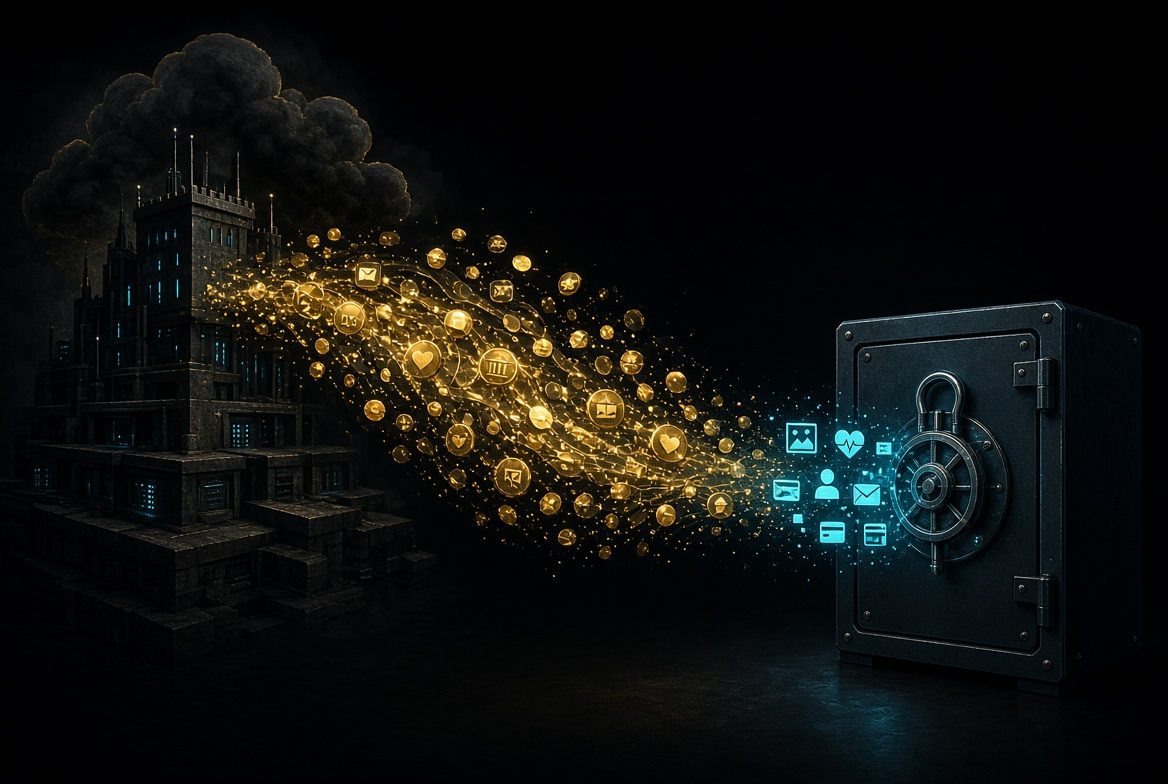
Platforms build profiles on you
Large consumer platforms do not merely host your messages and photos. They stitch activity across products into advertising and ranking profiles. Meta’s Accounts Center links Facebook, Instagram, and WhatsApp so signals from one surface can inform the others; WhatsApp has shared metadata with Facebook for years, and personalized ads on Meta properties draw on that combined picture. Google’s stack — Search, Maps, Android, Gmail, Analytics, ad networks — likewise aggregates intent, location, and browsing into durable identity graphs that power ads across the open web.
None of this is fringe theory. It is the stated business model: more than 95% of Meta’s revenue is advertising, which depends on detailed behavioral profiles. The same logic drives much of Google’s ads business. If you want the receipts, start here:
- FTC staff report on ISP data collection — providers combine product lines, browsing, and location and place people into sensitive categories.
- Meta’s cross-app data flows — how WhatsApp metadata and Accounts Center link into ad systems.
- noyb on WhatsApp ads fed by Instagram and Facebook data — the regulatory fight over linking services without freely given consent.
There is an entire industry of data brokers
Beyond the apps you open every day sits a quieter market: companies whose product is you. Data brokers collect, buy, infer, package, and resell personal information — often without any direct relationship with the person described. The FTC’s data broker report documented firms holding hundreds of billions of data elements covering nearly every U.S. consumer, drawn from commercial sources, public records, and online activity. Brokers assemble segments such as financial vulnerability, health-adjacent interests, and location histories, then sell those segments to marketers, fraud desks, and other buyers.
Recent enforcement shows how concrete the harms are. The FTC has moved against mass collectors of precise location and browsing data — including cases involving X-Mode, InMarket, Avast, and Kochava — for practices such as selling geolocation that can reveal visits to sensitive places, or packaging “audience” labels without meaningful notice.
This is not a side effect of the internet. It is a multi-billion-dollar industry optimized for compiling dossiers and selling access to them. Platforms feed the market; brokers refine and redistribute it; advertisers and other clients buy the result. You are the inventory in a supply chain you did not join on purpose.
- FTC on mass data collectors (Avast, X-Mode, InMarket)
- Lawfare on the FTC’s Kochava complaint and geolocation harms
- EPIC on the underregulated broker industry
Self-custody is the hardware-wallet move
Crypto already taught a generation the difference between “your coins on an exchange” and “your keys on a device you hold.” The same logic applies to life data. Leaving everything in Google Photos, WhatsApp, Instagram, and a dozen AI chat apps is the exchange model: easy, until it is not, and never truly yours.
Owning the hardware and the files means responsibility. Encrypt an external drive. Move sensitive material onto it. Export archives from the platforms that will give them to you — messaging, social, banking, health — and treat those exports as the start of a private corpus, not as clutter. Then process what matters into a local knowledge graph so the structure is queryable, not just a folder of zips.
The power of one private graph
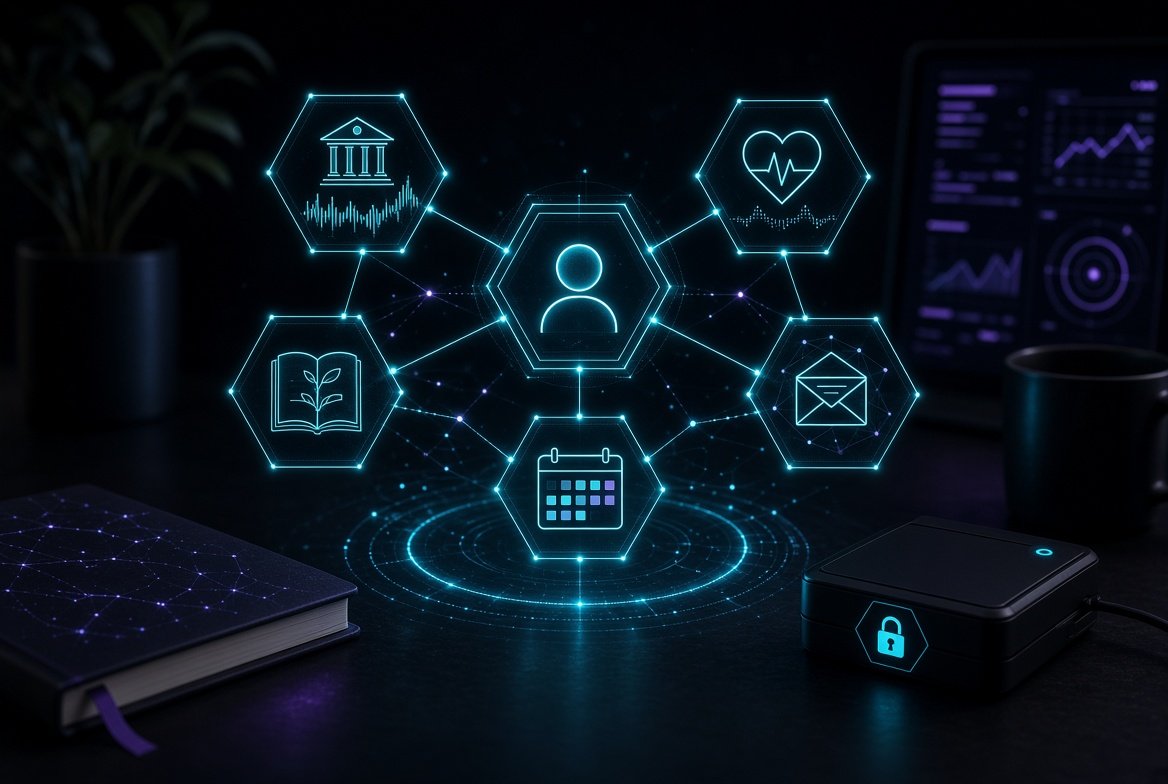
Scattered exports are still weak. The advantage appears when bank activity, health records, personal journals, calendar invites, and email live in one structure you control. Then correlations become visible without sending the raw material to a third party:
- Spending spikes against sleep and heart-rate trends from the same weeks
- Journal language before and after dense calendar stretches
- Medical follow-ups timed against travel and work travel in email and maps history
- Food and pharmacy purchases next to energy notes and workout gaps
Those links are exactly what ad systems and brokers approximate from the outside — with less fidelity and none of your interests at heart. On a local graph they become your diagnostics: patterns you can act on, share selectively, or keep sealed.
What you actually want from AI
You do want a system that has seen your medical timeline, your bank patterns, your food preferences, your exercise history, and the notes you wrote at 1 a.m. An assistant that knows you better than a generic model can is useful. The mistake is assuming the only way to get that is to pour the same material into a corporation whose business model is to extract surplus from attention, prediction, and lock-in.
A local stack flips the default. The model runs on your laptop’s own chip, not in a cloud you pay to access. The graph and the originals live on disks you control. You decide what is ingested, what is deleted, and what never leaves the room. If an AI company wants that corpus, the honest arrangement is compensation — not a free upload button wrapped in a friendly UI.
The Knowledge Graph as a reclaiming journey
The Knowledge Graph series is not only a product diary. It is a concrete path for that reclaiming: direct USB transfer so photo metadata and full-quality files survive; local speech and vision so recordings and photos never need a cloud API; a spatial canvas so memory is navigable without a feed algorithm; a job queue so multi-device use still stays on your network.
Export, encrypt, ingest, query. Repeat until the private graph is denser than any profile a platform or broker holds on you. Then the AI that helps you is trained on permissioned context — yours — instead of on the industrial byproduct of a billion other people’s unpaid labor plus your own.